
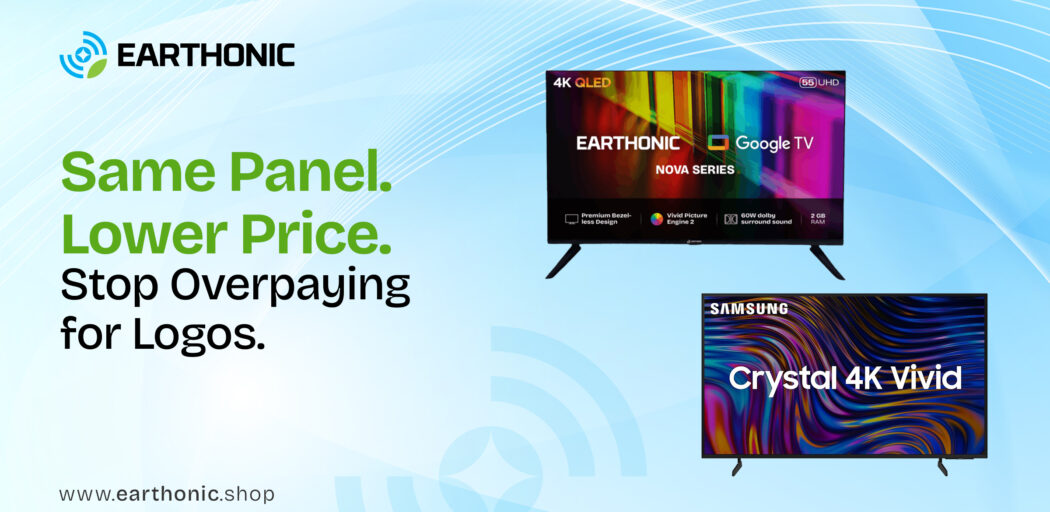
It is a scenario playing out in living rooms across India right now. Your neighbour just bought a shiny new 55-inch 4K TV. You paid ₹50,000 for your Samsung. They paid ₹38,000 for theirs. And honestly? You cannot tell the difference in picture quality.
This is not about brand loyalty. This is about understanding where your money actually goes. Let us break down the Samsung TV vs Indian TV brands price difference and show you why spending smart beats spending big.
See the same panel quality at a smarter price. Explore Earthonic's range of 4K Smart TVs and find your perfect match.
The Reality Check: What Actually Goes Into a TV?
A television is essentially four components in a box: a panel, a processor, software, and speakers. The panel accounts for roughly 60-70% of the manufacturing cost. Here is what most buyers do not realise: many brands source their panels from the same handful of manufacturers.
Component | Where It Comes From | Who Uses It |
LCD Panel | BOE, CSOT, AUO, Innolux | Samsung (budget models), TCL, Xiaomi, Earthonic, Hisense |
LED Backlighting | Global supply chain | All brands |
Processor | MediaTek, Realtek, Amlogic | Most non-premium brands |
Operating System | Android TV, Google TV, Tizen, webOS | Varies by brand |
According to industry data, the majority of panels used in the sub-₹50,000 segment come from the same Chinese and Taiwanese manufacturers. Samsung’s Crystal 4K series uses panels from these same suppliers. Earthonic’s 4K UHD TVs use panels from the same sources.
So where does the extra ₹12,000 go? You are paying for the logo, the marketing budget, and the premium placed on international brand perception.
Why Samsung TVs Are More Expensive in India
The question “why are Samsung TVs so expensive in India” has a straightforward answer. It is not because they use better panels in this price bracket. It is because of three factors:
Factor | Impact on Price |
Brand premium | Samsung invests heavily in marketing, celebrity endorsements, and retail presence. You are paying for that visibility |
Import duties | Many Samsung components are imported, adding 15-20% to the cost |
After-sales network | Samsung’s extensive service network is funded by higher margins on every TV sold |
Stat to note: A 91mobiles survey found that while Samsung commands a 13.8% ownership share in Indian households, customer retention for the brand stands at just 43.4%, significantly lower than Sony’s 59.2%. This suggests many Samsung buyers are willing to switch brands when upgrading.
Starting under ₹28,000. 4K UHD, Dolby Atmos, and 2-year warranty. Get the same picture quality at a smarter price.
Same Picture Quality, Cheaper TV: The Spec Comparison
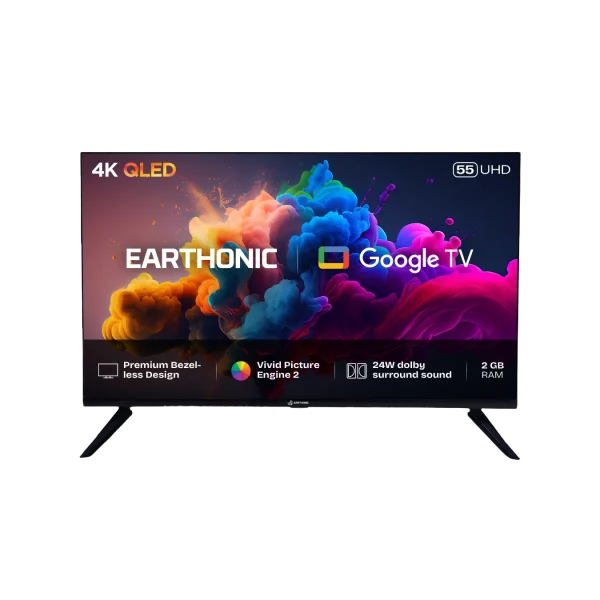
Let us put two TVs side by side. Samsung Crystal 4K 55-inch versus Earthonic 55-inch 4K UHD Smart LED TV.
Feature | Samsung Crystal 4K (55″) | Earthonic 55″ 4K UHD Smart LED TV |
Price | ~₹50,000 | ₹37,999 |
Panel | 4K UHD LED | 4K UHD LED |
Refresh Rate | 60Hz | 60Hz |
Audio | 20W | Dolby Audio (40W) |
RAM | 1.5GB | 2GB |
Storage | 8GB | 16GB |
Operating System | Tizen | Android 11 |
Warranty | 1 year | 2 years |
Notice anything? The Earthonic delivers more RAM, double the storage, significantly better audio, Android TV (which offers more app flexibility than Tizen), and a longer warranty. All at a lower price.
For buyers looking for the best budget 4K TV India has to offer, the value proposition is clear . You are not compromising on picture quality. You are simply avoiding the brand markup.
Want the Distance Math Behind These Sizes?
See exactly how seating distance, room shape, and screen size line up for 50, 55, and 65-inch TVs.
What You Are Actually Paying For (and What You Are Not)
Your ₹50,000 Samsung purchase gives you a few things your neighbour’s ₹38,000 TV does not have:
- A well-known logo – This matters if resale value or status is important to you
- Extensive service network – Samsung has more service centres in tier-2 and tier-3 cities
- Tizen OS – Some users prefer Samsung’s interface over Android TV
- Perceived quality – The psychological comfort of buying from a familiar global brand
What you are not getting:
Missing Feature | Why It Matters |
Superior panel quality | The panel is from the same supply chain as budget brands in this segment |
Better audio | Samsung often ships 20W speakers while Earthonic offers 40W Dolby Audio |
More storage | 8GB fills up fast with apps; 16GB gives you breathing room |
Extended warranty | Samsung typically offers 1 year; Earthonic offers 2 years |
Indian TV Brands vs Samsung 2026: The Verdict
The panel technology TV price debate is simple: if two TVs use the same panel technology from the same suppliers, the picture quality will be nearly identical. What changes is the brand tax you choose to pay.
Aspect | Samsung | Indian Brands (Earthonic) |
Panel source | Same global suppliers | Same global suppliers |
Picture quality | Good | Comparable |
Audio | Entry-level | Often superior |
Smart OS | Tizen | Android TV (more apps) |
Price | Premium | 20-30% lower |
Warranty | 1 year | 2 years |
The Indian TV market is expected to reach 30.4 million units in 2026, up from 20 million in 2022. This growth is being driven largely by value-conscious buyers who have realised that the same picture quality in cheaper TV options exist.
See How Earthonic Stacks Up Against Samsung Read our detailed comparison blog
Drive to Survive’s colour grading and HDR mastering reveal themselves differently on different panel types. Here’s what to look for.
When Does Brand Premium Actually Make Sense?
To be fair, premium pricing from international brands does make sense at higher price points. A Samsung QLED or Neo QLED with Mini-LED backlighting uses technology that budget brands cannot replicate at the same price. Similarly, LG’s OLED panels deliver true blacks that are genuinely superior.
But in the sub-₹50,000 segment? The differences are minimal. The panel technology is the same. The processor is often from the same chipmakers. The software experience is a matter of personal preference.
For most Indian buyers watching IPL, streaming Netflix, and using OTT apps, an Earthonic 4K UHD TV delivers the exact same experience as a Samsung Crystal 4K. The only difference is the extra cash in your wallet.
The Bottom Line: Spend Smart, Not Big
Your neighbour is not getting inferior picture quality. They are getting the same panel, more storage, better audio, and a longer warranty. They just chose not to pay the brand premium.
If you are in the market for a new TV, ask yourself: do you want to pay for a logo or for actual features? Do you want one year of warranty or two? Do you want 8GB of storage or 16GB?
The answer, for most buyers, is clear. The best budget 4K TV India offers is not the one with the biggest advertising budget. It is the one that delivers the most value for your money.
Upgrade your home entertainment without upgrading your budget. Explore Earthonic's full range of 4K Smart TVs.
Explore Earthonic’s 65-inch, 75-inch, and 85-inch 4K UHD Smart LED TVs with Google TV, HDR support, and Dolby Audio for the full Drive to Survive experience.
FAQs
1. Why are Samsung TVs priced higher than other brands in India?
Samsung TVs carry a premium price due to immense global marketing expenses, celebrity brand ambassadors, complex multi-tiered distribution networks, and import duties on specific components. In the entry-level and mid-range segments, this price gap represents a “brand tax” rather than a difference in fundamental hardware quality.
2. Does a higher price always mean better picture quality?
No, not in the sub-₹50,000 segment. While premium price points (above ₹80,000) offer proprietary tech like OLED or Mini-LED, budget 4K TVs across both international and Indian brands typically share the exact same underlying open-cell LED panels sourced from the same global suppliers.
3. What panel manufacturers do budget Indian TV brands actually use?
Indian TV brands, alongside global brands for their entry-level lineups, source their display hardware from major liquid-crystal display (LCD) conglomerates such as BOE, CSOT (TCL’s display arm), AU Optronics (AUO), and Innolux.
4. Is buying a non-Samsung 4K TV a compromise on quality?
It is not a compromise on structural or visual performance. Opting for a reputable brand like Earthonic often nets you superior secondary specifications—such as 40W Dolby Audio instead of 20W, 16GB of internal storage instead of 8GB, and an open Android TV ecosystem rather than a locked-down proprietary platform.
5. What adds to a TV's cost besides the display panel itself?
Beyond the display panel (which accounts for roughly 60-70% of production costs), a TV’s retail price is driven by the central processor, audio internal configuration, software licensing, internal storage arrays, factory assembly labor, domestic logistics, and post-sale service network operations.
6. How can I check if two TVs use the same panel source?
While brands rarely publicize their exact raw material suppliers on retail spec sheets, hardware review communities and supply-chain tracking databases frequently run teardowns. If two competitive models feature identical native contrast ratios, viewing angles, peak brightness nits, and sub-pixel geometries within the same budget tier, they likely utilize a shared panel origin.
7. Are Indian electronics brands reliable for long-term use?
Yes. Modern Indian brands leverage the exact same standard global supply chains for chipsets (like MediaTek) and panels as legacy giants. Because their assembly and quality control pipelines adhere to strict modern industry certifications, their long-term structural reliability is highly competitive.
8. What kind of warranty and after-sales support do budget Indian TV brands offer?
While legacy international brands typically limit their standard protection plan to a basic 1-year window, progressive home-grown brands like Earthonic offer an extended 2-year warranty. Support is managed through centralized customer hotlines coupled with expanding regional service networks to handle on-site assistance.