

Picture this. Lights out, eighteen cars launching off the grid, the field bunching into the first corner, and you’re squinting at a 32-inch screen from across the room trying to tell which car just took the lead. If that sounds familiar, your TV isn’t built for the way you actually watch sport anymore.
India’s television habits have changed faster than most living rooms have kept up. The sale of televisions over 32 inches has increased significantly in recent years, and large-screen TVs are now the fastest-growing segment in the country (Custom Market Insights, India Television Market Report). Yet millions of Indian households are still watching Grand Prix weekends, IPL finals, and Champions League nights on a screen sized for a bedroom, not a broadcast.
This guide breaks down exactly why that 32-inch screen is holding back your sports viewing experience, and what size actually delivers the immersive viewing experience today’s broadcasts are built for.
1. Why 32 Inches Was Never Built for Modern Sports?
Most 32-inch TVs were designed for an era of news bulletins and daily soaps, not 4K sports streaming. Today’s sports broadcasts use multiple wide-angle cameras, fast pans, and split-screen graphics, none of which were designed with a 32-inch frame in mind.
Here’s what actually happens on a 32-inch screen during a live race or match:
- Wide circuit or stadium shots lose all detail, and players or cars shrink into indistinct shapes
- On-screen graphics like lap timers, scoreboards, and player stats overlap and clutter a small frame
- You instinctively lean closer to see detail, which causes eye strain over a 2 to 3-hour broadcast
- Group viewing becomes difficult, since only the closest seats get a clear picture
Government data cited in industry reports confirms this shift. The sale of TVs above 32 inches has witnessed a significant increase in recent years, and the 32-inch segment’s market share is reported to be in steady decline as larger formats become the household norm (Custom Market Insights, 2026).
2. The Science of Why a Bigger Screen Is Better.
This isn’t just a marketing claim. It’s rooted in how human vision actually works. The home theatre industry follows the THX recommendation that a screen should fill roughly 40 degrees of your field of vision for a genuinely immersive experience, since humans naturally have close to 180 degrees of peripheral vision (Audioholics, THX Display Standards). A 32-inch screen, viewed from a typical Indian living room distance of 8 to 10 feet, fills only a small fraction of that.
Industry research on screen psychology also notes that when a display fills roughly 30 to 40 per cent of your horizontal field of view, your brain begins treating it as the primary environment rather than background noise. This is exactly why a large screen TV for sports viewing feels more ‘live’ and engaging than a smaller set ever can (Haier India, The Science Behind Immersion on Large Screens).
In simple terms, a bigger screen doesn’t just look better. It changes how your brain processes the action.
3. 32-Inch vs 65-Inch: The Real Comparison
Here’s how the two sizes stack up across the factors that actually matter for daily and match-day viewing:
Factor | 32-Inch TV | 65-Inch 4K Smart TV |
Ideal viewing distance | 4 to 6.5 feet | 6.5 to 8 feet |
Field of view at 8 ft | Roughly 13 to 15 degrees | Roughly 30 to 35 degrees |
Detail in wide shots | Poor, needs close seating | Sharp from across the room |
Group viewing comfort | Limited to 2 to 3 people | Comfortable for 5 to 8 people |
Typical resolution | HD / Full HD | 4K Ultra HD |
Suitability for live sports | Basic | Strongly recommended |
A 65-inch 4K screen doesn’t just look larger. It’s built around a resolution that supports closer, more detailed viewing without losing picture quality, which is exactly what fast-moving sports content demands.
Already decided on a bigger screen?
Here’s how to pick between 50, 55, and 65 inches based on your room and your IPL viewing habits.
4. Finding Your Ideal Screen Size: A Quick Viewing Distance Guide.
The right screen size depends on how far your seating is from the wall, not just your room size. For 4K Ultra HD TVs, the general rule is to sit at roughly 1 to 1.5 times the screen’s diagonal size (Panasonic UK, TV Size to Viewing Distance Guide).
Seating Distance | Recommended Screen Size |
5 to 6.5 feet | 55 inch |
6.5 to 8 feet | 65 inch |
7.5 to 9.5 feet | 75 inch |
8.5 to 11 feet | 85 inch |
If your living room seating is more than 8 feet from the wall, a 65-inch screen is likely the minimum size worth considering, with a 75-inch screen recommended for larger rooms. For a closer look at making the most of generous room sizes, see our guide on the best 75-inch TVs for large living rooms
5. What You Gain Beyond Just Size?
Upgrading from a 32-inch TV is rarely just about screen dimensions. It typically means moving into a different tier of technology altogether:
- 4K Ultra HD resolution, compared to the HD or Full HD panels common in 32-inch models
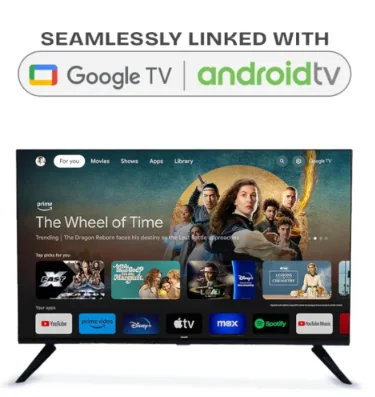
- Smart TV platforms like Google TV or Android TV, with native access to sports streaming apps
- Higher refresh rates, which matter significantly for fast-moving sports such as Formula 1, football, and cricket
- HDR support, which improves visibility during night races, floodlit matches, and variable lighting conditions
- Wider colour and contrast range, making broadcast graphics, replays, and on-screen data far easier to read
This is particularly relevant for motorsport fans. The best TV for Formula 1 needs to keep pace with cars exceeding 300 km/h, render tyre and track detail accurately, and handle rapid lighting shifts between sunlit straights and shadowed corners. A 32-inch HD panel simply isn’t built for that workload, regardless of how close you sit to it.
Considering an 85-inch upgrade instead?
Before you commit to the biggest screen on the shelf, check our complete buyer’s guide on installation, wall strength, and viewing distance.
6. Common Mistakes While Upgrading Screen Size
- Upgrading size but not resolution: Moving from 32 to 50 inches without checking for 4K means you’re stretching a lower-resolution image across more pixels, which can make detail look softer, not sharper.
- Ignoring viewing distance entirely: A 75-inch screen at 4 feet away is overwhelming, just as a 32-inch screen at 10 feet away is disappointing. Match the size to your actual seating distance.
- Skipping the installation check: Larger TVs need solid wall support and adequate doorway clearance. Our breakdown of the top 5 giant screen TV buying mistakes covers this in detail before you commit to a size.
- Forgetting sound: Larger screens often have thinner built-in speakers relative to their size. A soundbar closes this gap and makes the upgrade feel complete.
Final Word
Sports broadcasts have evolved. Camera work, graphics, and streaming quality have all moved toward 4K and large-format viewing, but a large share of Indian living rooms are still anchored to a 32-inch screen built for a different era of television. The upgrade from a 32-inch TV to a 65-inch or larger 4K Smart TV isn’t just about size. It’s about matching your screen to the way modern sport is actually broadcast, filmed, and meant to be watched.
If the next Grand Prix, IPL final, or title decider deserves your full attention, it deserves a screen built for it too.
Ready to Upgrade Your Sports Viewing Setup?
Explore Earthonic’s 65-inch, 75-inch, and 85-inch 4K UHD Smart LED TVs, built for immersive, detail-rich live sports viewing.
FAQs
1. Is a 32-inch TV too small for sports?
For most living rooms with seating 7 feet or further from the screen, yes. A 32-inch TV is designed for close-range, single-person viewing rather than the wide shots and fast motion typical of live sports broadcasts.
2. Should I buy a 65-inch or 75-inch TV?
This depends on your seating distance. A 65-inch TV suits rooms where seating is 6.5 to 8 feet from the screen, while a 75-inch TV is better suited to 7.5 to 9.5 feet. Measure your actual room before deciding.
3. What is the ideal TV size for a living room?
For the average Indian living room, with seating between 7 and 9 feet from the wall, a 65-inch or 75-inch 4K Smart TV typically offers the best balance of immersive viewing and comfortable visibility.
4. Does a bigger TV improve sports viewing?
Yes, when paired with the right viewing distance. A larger screen fills more of your natural field of vision, which research shows increases the sense of presence and immersion during live broadcasts.
5. How far should I sit from a 75-inch TV?
The recommended viewing distance for a 75-inch 4K TV is roughly 7.5 to 9.5 feet, based on the standard rule of sitting at 1 to 1.5 times the screen’s diagonal size.
6. Is 4K necessary for sports?
4K resolution makes a noticeable difference in sports viewing because it renders fine detail like player numbers, ball seams, and track surfaces clearly, even on large screens viewed from a normal distance.
7. Is an 85-inch TV worth it?
An 85-inch TV is worth it for larger rooms with seating beyond 8.5 feet, or for those who want a true cinema-style viewing experience. It requires solid wall support and adequate space, so check installation requirements first.
8. Which Earthonic TV is best for large rooms?
For larger Indian living rooms, the Earthonic 75-inch and 85-inch 4K UHD Smart LED TVs are best suited, offering the screen real estate and resolution needed for an immersive, theatre-like sports viewing experience.