
AI is suddenly everywhere. It writes emails, edits photos, answers questions and even helps you plan holidays. Now, it wants a place in your living room too.
Walk through a television showroom in 2026 and you will see terms like “AI-powered,” “AI processor,” “intelligent picture” and “AI sound” appearing across product descriptions. It sounds impressive, but there is an obvious question: do you actually need any of it?
If you are shopping for a new television from Earthonic or comparing models online, understanding what an AI TV actually does can help you avoid paying extra for a fancy label.
The answer is not that AI is useless. Some features can make everyday viewing noticeably better. The trick is knowing which ones deserve your attention.
First Things First: What Is an AI TV?
If you have been wondering what is an AI TV, think of it as a smart television that uses intelligent processing to automatically improve or personalise parts of your viewing experience.
A regular smart TV connects to the internet, runs streaming apps and may support voice commands. A smart TV with AI goes further by analysing content, viewing behaviour or other inputs to make adjustments automatically.
Depending on the television, AI features in television can include picture enhancement, sound optimisation, voice control, content recommendations and smart home integration.
That sounds futuristic, but some of these technologies have existed in simpler forms for years. What has changed is how sophisticated the processing has become and how heavily manufacturers are marketing it.
For a closer look at the technology behind these claims, read AI on Your Smart TV: What It Actually Does.
The AI TV Features That Could Actually Matter
Not every feature carrying the AI label deserves equal attention. Here are the ones that can make a meaningful difference.
1. AI Picture Optimisation
Your family probably does not watch one type of content all day. One minute it is a cricket match, then a movie, a YouTube video or an old TV show.
AI picture optimization can analyse what is playing and automatically adjust elements such as contrast, brightness, colour and motion. Some systems can also reduce noise in lower-quality video.
The benefit is convenience. Instead of constantly changing picture modes, the television tries to optimise the image for you.
2. AI Upscaling
This is arguably one of the most useful applications of AI in modern 4K televisions.
Not everything you watch is native 4K. Older movies, cable channels and online videos may have significantly lower resolutions. Upscaling helps these sources fit a 4K screen, while more advanced processing can analyse frames and reconstruct details to produce a sharper-looking result.
Of course, it cannot magically turn a poor-quality video into true native 4K. But good processing can make lower-resolution content more enjoyable on a large screen.
If resolution is high on your buying checklist, understanding the broader benefits of a 4K Smart TV is equally important.
3. AI Sound
Ever watched a movie where the background music is booming but the dialogue feels impossible to hear?
AI sound processing can analyse audio and make automatic adjustments, including improving dialogue clarity or adapting sound to different types of content. However, processing still depends heavily on the television’s physical speakers. AI cannot completely compensate for weak audio hardware.
So, consider AI audio a useful enhancement, not a replacement for good speakers.
4. Smarter Recommendations
The “What should we watch?” debate may never disappear completely, but AI is trying.
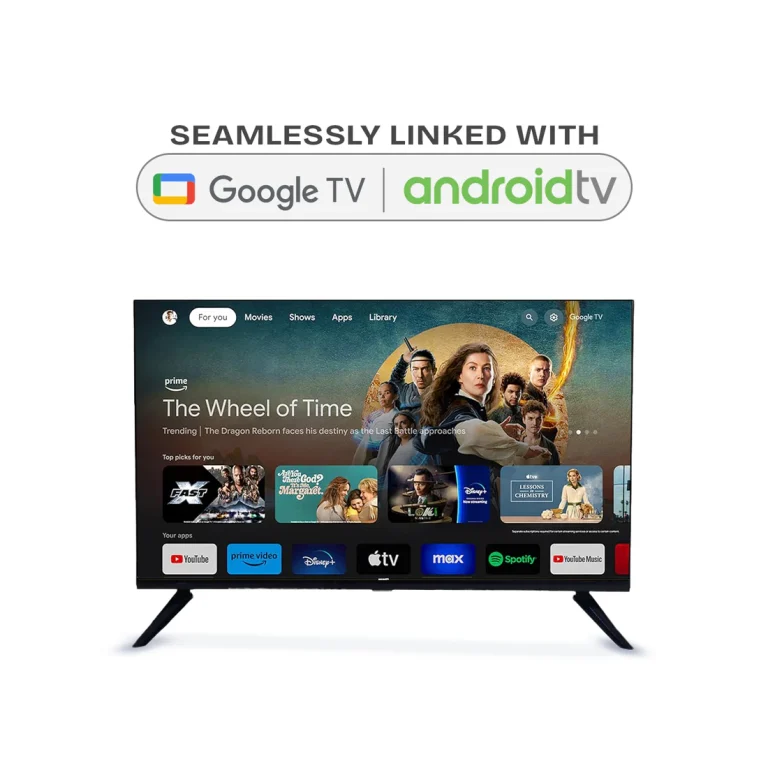
Modern platforms can learn from viewing habits and surface shows or movies that match your interests. Google TV, for example, takes a content-focused approach and can aggregate recommendations from different streaming services.
These content recommendations are convenient, particularly if your household uses multiple streaming platforms. Still, they are probably not a reason on their own to spend significantly more on a television.
The software platform also matters here. Before buying, compare Google TV vs Android TV to understand how each approaches navigation, personalisation and content discovery.
5. Voice Control and Smart Home Features
Voice assistants have been part of televisions for a while, but they are becoming more conversational. Instead of navigating through menus or typing with a remote, you may be able to search for content using natural language.
Some televisions can also work as part of a connected home, allowing compatible smart devices to be controlled through the TV ecosystem. Google TV and Android TV, for instance, support Google Assistant-based smart home controls.
Useful? Absolutely, for the right household. Essential? Probably not.
So, Is an AI Smart TV in 2026 Really Better?
This is where the marketing needs a reality check.
An AI smart TV 2026 model is not automatically better than every television without a huge AI badge on the box. Intelligent TV features are only one part of the experience.
Panel quality, resolution, brightness, contrast, refresh rate, processing power, speakers, operating system and connectivity still matter.
Think of AI as an assistant working behind the scenes. If the underlying hardware is good, intelligent processing can help you get more from it. If the hardware is mediocre, adding an “AI-powered” sticker does not suddenly create a premium viewing experience.
Earthonic’s own guide reaches a similar conclusion: AI enhancements can be useful, but the quality of the underlying panel, speakers and smart platform remains fundamental
Want the Distance Math Behind These Sizes?
See exactly how seating distance, room shape, and screen size line up for 50, 55, and 65-inch TVs.
When Should You Actually Care About AI?
AI deserves more weight in your buying decision if you:
- Watch plenty of HD or older content on a 4K screen
- Want the TV to adjust picture and sound automatically
- Frequently use voice search
- Like personalised recommendations across streaming platforms
- Have compatible connected-home devices
On the other hand, you probably should not pay a large premium for AI alone if your priority is simply a good display, reliable software and strong sound.
This distinction matters in the Indian market, where value for money often matters as much as having the newest feature. Before getting distracted by buzzwords, look at the complete package. You can also explore why Earthonic is positioned as a smart choice for Indian homes when comparing what you get for your budget.

AI Is a Feature, Not the Reason to Buy a TV
In 2026, AI is becoming a meaningful part of television technology, but it should not become the only thing you look at.
The best AI TV features solve small but real problems. They can make lower-resolution content look better, improve dialogue clarity, simplify searches and reduce the time you spend adjusting settings. Those improvements can add up to a more convenient everyday viewing experience.
But no amount of artificial intelligence can rescue a poor display or weak hardware.
So, should you care about AI TVs? Yes, but care about how the AI helps you rather than how prominently the word “AI” appears on the box.
When choosing your next television, prioritise the overall viewing experience and then treat useful AI capabilities as a bonus. Explore the latest Earthonic smart TVs and displays to find a television that focuses on what matters when you actually sit down and press play.
FAQs
1. What is an AI TV?
An AI TV is a smart television that uses intelligent processing or machine-learning-based technology to enhance features such as picture, sound, recommendations or voice interactions.
2. What does AI actually do on a smart TV?
AI can analyse content and automatically optimise picture and sound, improve upscaling, personalise recommendations and make voice searches more intuitive.
3. Are AI TVs worth buying in 2026?
They can be, especially if the AI functions improve features you regularly use. However, good hardware and display quality should still take priority over AI branding.
4. Does AI improve TV picture quality?
Yes, good AI processing can improve aspects such as upscaling, noise reduction, contrast and scene-based picture adjustments, although results depend on the TV’s processor and panel.
5. Can AI improve TV sound?
AI can improve dialogue clarity and automatically optimise audio for different content, but it cannot completely compensate for poor-quality speakers.
6. Is AI TV different from a smart TV?
Yes, although the categories overlap. A smart TV primarily offers internet-connected apps and services, while an AI-enabled model adds intelligent processing and adaptive features.
7. Do AI TVs require an internet connection?
Some on-device picture and audio processing may work without the internet, but online recommendations, streaming, cloud-based assistants and certain smart features generally require connectivity.
8. What should I look for when buying an AI TV?
Prioritise panel quality, resolution, sound, processor performance, operating system and connectivity first. Then compare AI capabilities based on whether they offer practical benefits for your viewing habits.