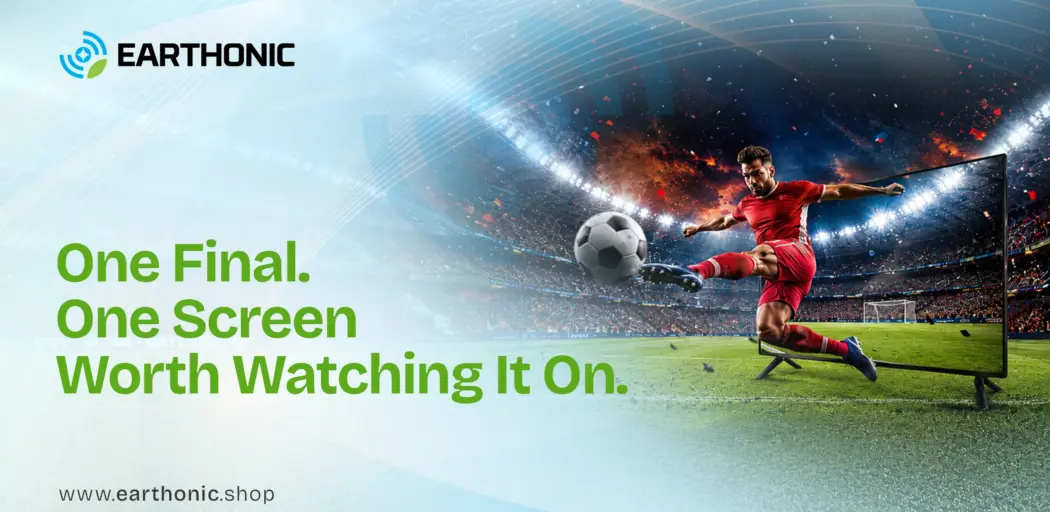
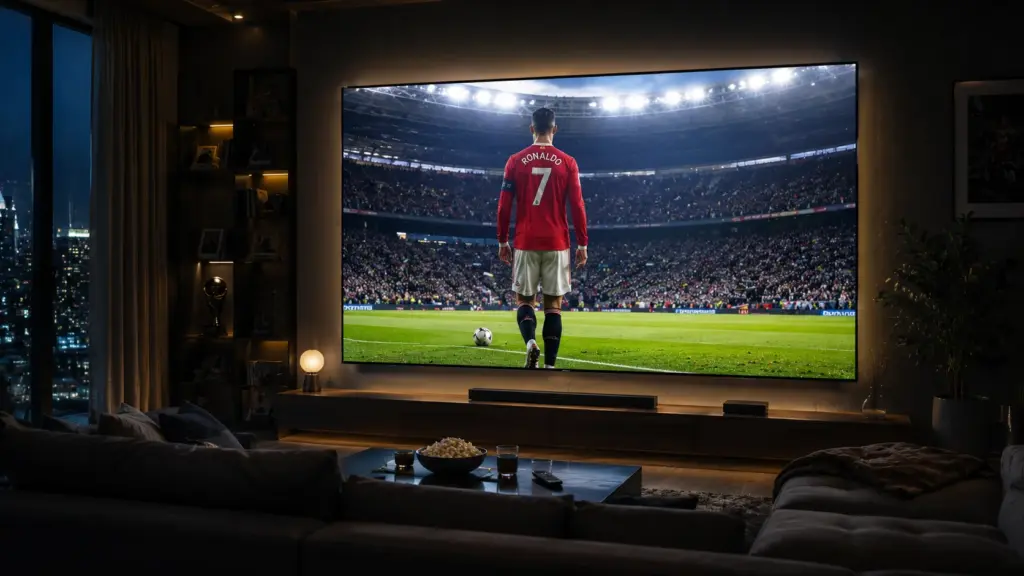
July 19 is circled on many calendars. The FIFA World Cup 2026 Final kicks off at MetLife Stadium, closing out a 48-team, 104-match tournament that has already pulled in record numbers wherever it has aired. FIFA’s own engagement report put the 2022 Final at 1.42 billion viewers, the single biggest audience any sporting fixture has drawn, and this edition is tracking even higher, with projections of roughly 1.6 billion viewers for the Final alone. India did its part too, with opening-weekend coverage alone drawing over 100 million viewers here.
Here is the catch. A lot of those Indian viewers will be watching on a TV bought for daily news and serials, not a 90-plus-minute global final with cameras chasing a ball at sprint speed. This World Cup TV guide is built to fix that before kickoff, not after.
1. The 60-Second Self-Test: Will Your Current TV Survive the Final?
Before spending a rupee, run through this. Answer honestly.
- Can you read the scoreline graphic from your usual seat without leaning forward?
- Does the spec sheet show 100Hz or 120Hz, not just a marketing “Motion Rate” number?
- Is your panel genuinely 4K Ultra HD, or still capped at HD or Full HD?
- Can your Smart TV open a streaming app directly, with no separate box involved?
- Has your Wi-Fi actually carried a full match in HD or 4K before, tested, not assumed?
If you answered no to two or more of these, keep reading. These five checks are roughly how buying guides quietly define the best TV for football matches: a size matched to your room, a true refresh rate, native 4K, app-ready software, and bandwidth that has actually been tested.
2. Match Your TV to Your Watch-Party Style, Not Just Your Room
Most size guides start with a tape measure. Start with the guest list instead. Finding the best TV for FIFA World Cup night has less to do with how far you sit from the wall and more to do with who is actually going to be in the room on July 19.
|
Viewing Style |
Typical Group |
Recommended Size |
Why It Works |
|
Solo or couple, late-night highlights |
1-2 people |
50 inch |
Compact rooms, close seating, full 4K detail without overkill |
|
Family Sunday viewing |
3-5 people |
65 inch |
The most common fit for a standard Indian living room sofa |
|
Friends’ watch party |
6-10 people |
75 inch |
Clarity holds up even from the back row of chairs |
|
Building a lounge or society screening |
10+ people |
85 inch |
Stadium-scale energy without a stadium-scale queue |
Want the Distance Math Behind These Sizes?
See exactly how seating distance, room shape, and screen size line up for 50, 55, and 65-inch TVs.
Want the Distance Math Behind These Sizes?
See exactly how seating distance, room shape, and screen size line up for 50, 55, and 65-inch TVs.
3. The Hidden Spec Most Buyers Skip: Refresh Rate
Picture a penalty shootout. A player strikes, the keeper dives, and the broadcast cuts to a slow-motion replay half a second later. A 60Hz panel handles a calm studio discussion just fine, but feed it a sprint to a loose ball or a fast counter-attack, and the picture starts to drag, with players smearing slightly as they move. A 120Hz panel doubles the number of frames drawn every second, and that is the spec that actually sharpens motion handling on screen during a sprint, not a number printed on the box (American TV, Refresh Rate Guide, 2025).
Manufacturers often quote a “Motion Rate” figure that sounds two or three times higher than the real refresh rate. Always check the native Hz spec before buying for football, since that is the number broadcasters and motion-processing engines actually work with (Practical Home Theatre Guide, 2026).
4. 4K vs HD: What You Are Actually Missing During 4K Football Matches
As of 2026, 4K Ultra HD panels hold an estimated 64 per cent share of the Indian smart TV market and are the default above 43 inches (Fact.MR, Smart TV Market Report, 2026). The gap below is not theoretical. It is what changes on your own screen during a live broadcast.
|
What You Are Watching |
On HD / Full HD |
On 4K Ultra HD |
|
Jersey numbers in a wide shot |
Often blurred or unreadable |
Clearly legible |
|
Grass and pitch markings |
Flat, lacks texture |
Sharp, textured detail |
|
Frozen replay frames |
Soft, slightly pixelated |
Crisp, broadcast-quality |
|
Floodlit night passages (with HDR) |
Highlights washed out, shadows lost |
Balanced contrast, detail visible at both ends |
Most Indian Living Rooms Land Right Here
The 65-inch 4K UHD Smart LED TV hits the sweet spot for family Sunday viewing and World Cup night alike.
5. Sound and Sports Streaming: The Other Things Nobody Mentions.
A genuine football streaming TV setup needs two things to work equally well: app access and audio. Built-in TV speakers, especially on slim panels, rarely do justice to a full stadium roar, so a soundbar or a compact 2.1 system is worth the spend if you are hosting people over.
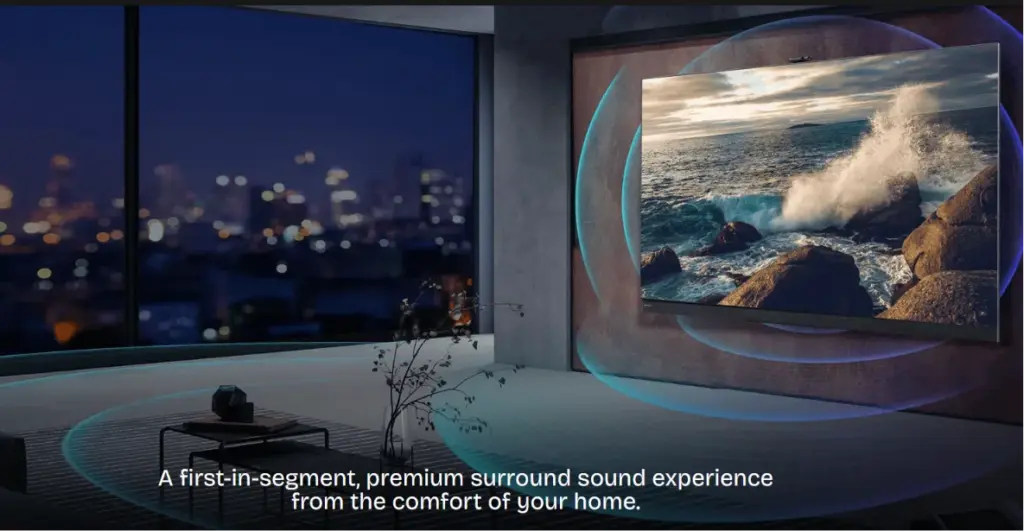
On the streaming side, sports TV India habits have moved firmly toward Smart TV platforms. The country’s smart TV and OTT market is projected to grow from roughly USD 22.39 billion in 2025 to USD 26.39 billion in 2026, en route to USD 60.05 billion by 2031 (Mordor Intelligence, India Smart TV and OTT Market Report, 2026). Make sure your platform opens the broadcaster’s app directly, and that the connection has been stress-tested with an actual match, not just a YouTube clip, well before July 19.
If your setup already handled IPL 2026 without buffering, you are most of the way there; our guide on streaming IPL 2026 on a Smart TV runs through the same app and bandwidth checks for football.
6. Three Things Fans Get Wrong Before Kickoff
- Trusting the marketing number: a high “Motion Rate” on the box does not mean a high native refresh rate. Ask for the real Hz spec.
- Going bigger without checking the room: a giant screen TV mounted too close turns immersive into uncomfortable fast, regardless of how good the panel is.
- Leaving the dry run for July 19: soundbar pairing, app logins, and a Wi-Fi stress test all take ten minutes, a few days early. They take a lot longer mid-match. If budget is the real constraint this year, start with our guide to the best smart TVs under ₹20,000 instead of skipping the upgrade altogether.
Final Word
MetLife Stadium will be packed on July 19. Your living room can hold its own version of that energy, but only if the screen, sound, and connection are actually ready for it. The goal was never just a bigger screen. It is a football viewing experience that actually matches the scale of the moment.
Kickoff Is Closer Than You Think
Browse Earthonic’s 50, 65, 75, and 85-inch 4K UHD Smart LED TVs and get your setup sorted before July 19.
FAQs
1. What is the best TV for football matches?
The best TV for football matches combines 4K Ultra HD resolution, a refresh rate of at least 120Hz, and a screen size matched to your seating distance. Together, these three factors determine how clearly you can follow fast play, wide stadium shots, and on-screen graphics during a live broadcast.
2. Is a 75-inch TV good for sports?
Yes. A 75-inch TV is well suited to sports viewing for seating distances of roughly 7.5 to 9.5 feet, making it a strong choice for larger living rooms and small watch parties where multiple viewers need a clear view of fast-moving action.
3. What TV settings are best for football?
For live football, switch to a Sports or Vivid picture mode if available, enable motion smoothing at a moderate level to reduce blur, and turn on HDR if your source supports it. Avoid cinema or filmmaker modes, which are tuned for film frame rates rather than live sport.
4. Does refresh rate matter for football?
Yes, significantly. A higher refresh rate, ideally 120Hz, reduces motion blur during fast breaks, sprints, and quick camera pans, which are constant in football broadcasts. A standard 60Hz panel can leave trailing or smeared motion during rapid play.
5. What screen size is best for the FIFA World Cup?
This depends on your seating distance more than your room size. As a general guide, 50-inch suits 5 to 6.5 feet, 65-inch suits 6.5 to 8 feet, 75-inch suits 7.5 to 9.5 feet, and 85-inch suits 8.5 to 11 feet.
6. Is 4K worth it for sports fans?
Yes. 4K resolution renders fine detail such as player numbers, ball seams, and pitch texture clearly, even on large screens, and it has become the standard resolution for major tournament broadcasts, including the FIFA World Cup.
7. Which TV offers the best viewing angles?
TVs using IPS or wide-viewing-angle VA panel technology hold colour accuracy and contrast better off-centre, which matters for group viewing where not everyone is seated directly in front of the screen. Check the panel specification before buying if watch parties are a priority.
8. Which Earthonic TV is best for football fans?
For most Indian living rooms, Earthonic’s 65-inch and 75-inch 4K UHD Smart LED TVs offer the best balance of size, resolution, and group viewing comfort for football. Larger rooms or bigger watch parties can step up to the 85-inch model for a true stadium-scale experience.